
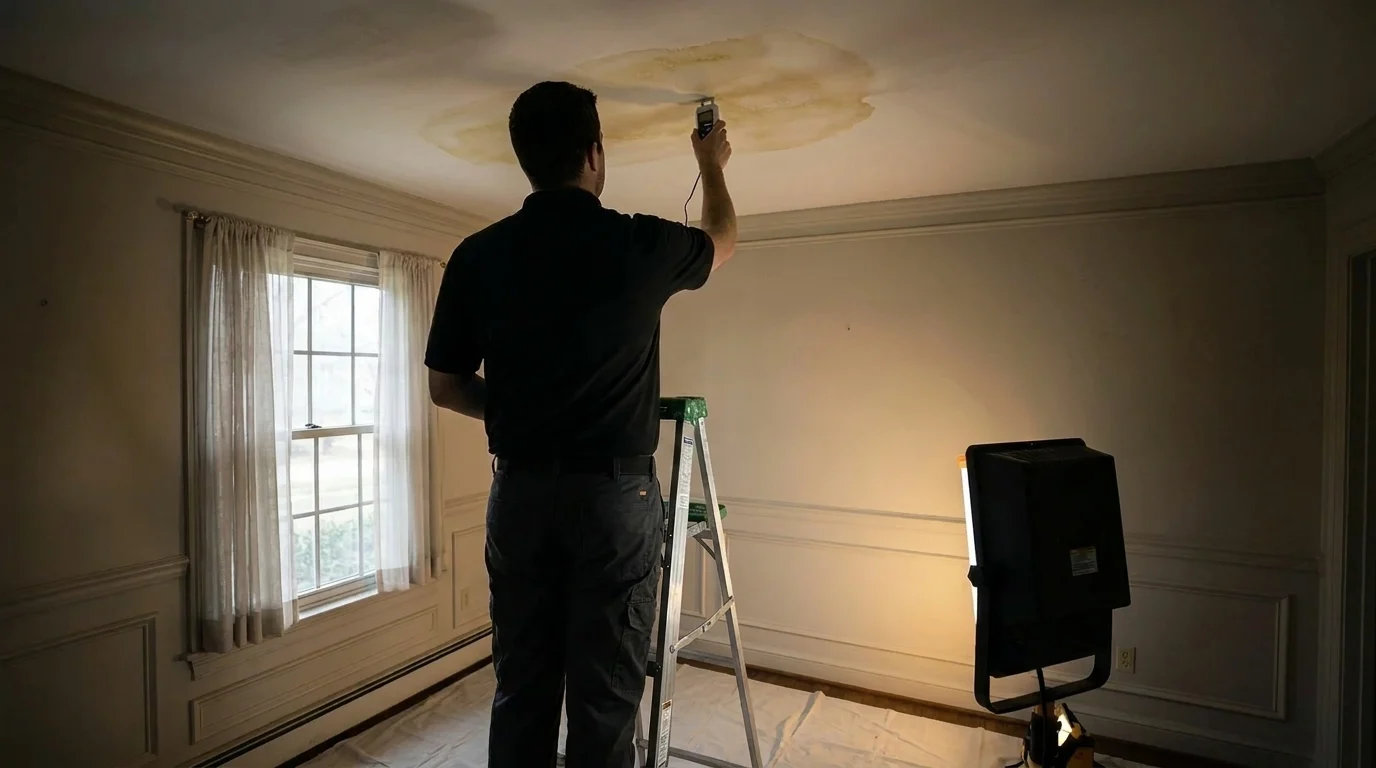
TL;DR: In Woodbridge, VA, ceiling water damage repair runs from about $150 to prime and repaint a small dried stain, up to $3,000 to $7,500 or more when a section has sagged or collapsed and needs new framing. Most single-room repairs after an upstairs bathroom leak or a roof leak land between $400 and $2,500, depending on how much drywall, insulation, and framing actually got wet and how long the moisture sat before anyone caught it.
If you’ve got a yellow-brown ring spreading across your bedroom ceiling under the upstairs bathroom, or a soft spot that gives when you press a finger into it, you’re trying to answer two things at once: what this is going to cost, and whether you can get away with just repainting it. The honest answer depends almost entirely on one factor: whether the water is still trapped in the material or already dried out.
How much does ceiling water damage repair cost in Woodbridge, VA?
Ceiling water damage repair in the Woodbridge area typically costs $150 to $7,500, with the price driven almost entirely by how far the damage progressed before it was addressed. A dried stain is a paint job. A soaked section is a tear-out and rebuild. A sagging or collapsed section is a structural repair.
| Scenario | Typical cost range |
|---|---|
| Dried stain only, no sag, stain-blocking primer and repaint | $150 - $400 |
| Small drywall patch (1-4 sq ft cut-out, dry, re-hang, texture, paint) | $400 - $900 |
| Larger section replacement, one room, texture and color match | $900 - $2,500 |
| Sagging ceiling with wet insulation removal and replacement | $1,500 - $3,500 |
| Collapsed panel with joist or truss inspection and framing repair | $3,000 - $7,500+ |
| Drying equipment (air movers, dehumidifier, 2-5 days) when caught early | $500 - $1,500, often a separate line item |
These are typical ranges for older colonials and split-levels common around Lake Ridge, Dale City, and the neighborhoods near Potomac Mills, where second-floor bathrooms sit directly over first-floor living spaces and a slow leak has a straight shot down into the ceiling below. Every job gets a written scope before work starts; these numbers are a planning tool, not a quote.
What drives the price up or down?
The biggest cost factor is response time: a stain caught and dried within 24 to 48 hours often needs only cosmetic work, while the same leak left for a week usually means cutting out drywall and insulation. A few other things move the number:
- Category of water. Clean water from a supply line dries differently than gray water from an overflowing tub or washing machine discharge, which usually means removing porous materials rather than drying them in place.
- Square footage affected. A single dinner-plate-sized stain costs far less than a ceiling that’s absorbed water across multiple joist bays.
- Insulation. Wet blown-in or batt insulation above the ceiling has to come out; it doesn’t dry in place and re-use is not recommended.
- Texture and paint matching. Popcorn or knockdown texture on an older Woodbridge home sometimes needs a texture match across the whole ceiling, not just the patched section, to avoid a visible seam.
- Access. Vaulted or cathedral ceilings cost more to repair than a standard 8-foot flat ceiling because of scaffolding and extra labor.
Will homeowners insurance cover ceiling water damage repair?
Most standard homeowners policies cover ceiling damage when it’s from a sudden, accidental discharge, like a supply line that bursts or a toilet that overflows unexpectedly. What they typically don’t cover is damage from a slow, ongoing leak that built up over weeks or months through neglect or poor maintenance, which insurers treat as a maintenance issue rather than a covered loss.
That distinction matters for a ceiling stain specifically, because a stain that’s been there for a while is exactly the kind of evidence an adjuster looks for to argue it was gradual. Photographing the damage as soon as you notice it, and getting a written moisture assessment, helps establish the timeline. For a fuller breakdown of what’s typically covered and what isn’t, see our guide to homeowners insurance and water damage and the Insurance Information Institute’s overview of standard homeowners coverage. 24/7 restoration Inc documents moisture readings and photos at every step specifically to support that claim.
What does the repair process actually look like?
Ceiling repair after water damage generally follows the same sequence regardless of severity, just with more or fewer steps depending on how far the damage went:
- Stop the source. Shut off the supply line, repair the roof flashing, or fix whatever’s actively leaking before anything else happens.
- Assess with a moisture meter. A technician checks how far the moisture traveled into the drywall, insulation, and framing, not just what’s visible.
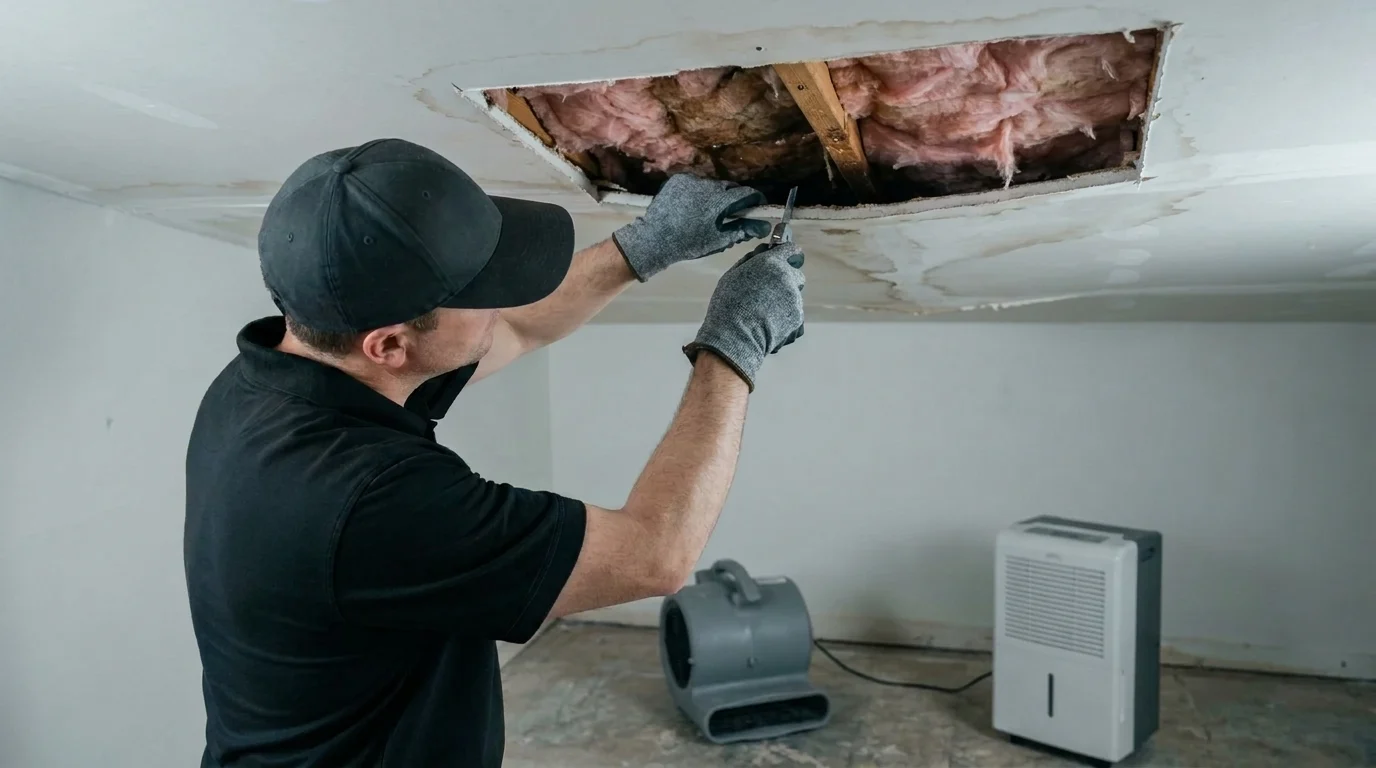
- Dry in place or remove. If the drywall is still structurally sound and the water is clean, drying it with air movers and a dehumidifier per the ANSI/IICRC S500 water damage standard can save the ceiling. If it’s saturated or sagging, it comes out.
- Inspect framing. A sagging or collapsed section gets the joists or trusses checked before any rebuild starts, since prolonged moisture can weaken wood over time.
- Rebuild. New drywall gets hung, taped, textured to match, primed, and painted.
Our water damage restoration page covers the drying and mitigation side of this in more detail, and our reconstruction services cover the rebuild once drying is complete. We offer dedicated ceiling water damage repair because the two phases, drying and rebuilding, are usually handled by different contractors, which slows a job down and adds cost. For the full cost breakdown across all water damage types, our Woodbridge water damage restoration cost guide has more detail.
When should you patch it yourself vs call a professional?
A small, dry stain with no sag, no cracking, and no odor is usually fine to prime with a stain-blocking primer and repaint yourself, as long as you’ve actually confirmed the leak is fixed. Anything beyond that, cracking paint, a spongy spot, visible sagging, or a stain that keeps spreading, means there’s still trapped moisture or compromised material, and that’s a job for a professional assessment.
A ceiling that’s visibly bowing or has already dropped a chunk of drywall is a safety issue, not a cosmetic one: wet drywall and insulation are heavy, and a weakened joist can let go without much warning. If you’re looking at sagging or a partial collapse, get it inspected before anyone spends time in the room below it.
If your Woodbridge home has a ceiling stain, sag, or collapsed section right now, call 24/7 restoration Inc at (703) 727-0385 for a moisture assessment. We handle the drying and the rebuild as one project, with a written scope before any work starts.
About 24/7 restoration Inc
24/7 restoration Inc is an IICRC Certified Firm (license #2705199581) based in Woodbridge, VA, holding IICRC Water Restoration Technician and Applied Microbial Remediation Technician certifications, with staff trained in OSHA safety practices and EPA Lead-Safe work practices. The company handles water damage restoration, sewage cleanup, general contracting, and reconstruction across Woodbridge, Dale City, Lake Ridge, and the wider Northern Virginia area, and is rated 5.0 on Google across 60 reviews. They offer 24/7 emergency service for active water damage.